
Note from the Author
The best lighting conditions for orchids was the first lesson I had to master when I started growing these plants at home. I lost my first Phalaenopsis because I placed it on a bright windowsill without protection, and its leaves scorched in a matter of days. Years later, after experimenting with natural and artificial setups, I can confirm that learning the best lighting conditions for orchids is the most powerful step any beginner can take. With the right light, even a small collection of orchids can bloom spectacularly and repeatedly.
The best lighting conditions for orchids
The best lighting conditions for orchids are those that mimic their natural tropical habitats. In the wild, many orchids grow under tree canopies where light is bright but filtered. Indoors, we must replicate that balance. Too little light leads to lush leaves but no flowers, while too much light burns foliage. Finding the best lighting conditions for orchids requires careful observation, adapting placement, and sometimes supplementing with artificial lighting. This guide provides the knowledge and strategies you need to make sure your orchids always get just the right amount of light.
Search Intent
The best lighting conditions for orchids explained in detail, covering natural placement, artificial grow lights, seasonal adjustments, and practical care tips.
Audience
Beginners, home growers, and orchid enthusiasts who want their plants to bloom consistently and stay healthy with correct lighting indoors.
Table of Contents
- Why Lighting Matters for Orchids
- How to Recognize Light Stress in Orchids
- The Best Natural Lighting Conditions for Orchids
- Light Needs by Orchid Type
- Artificial Lighting for Orchids
- How to Use Artificial Light Safely
- Seasonal Adjustments for Orchid Lighting
- Common Mistakes to Avoid
- Advanced Light Optimization Strategies
- 30-Day Orchid Lighting Plan
- Mini FAQ
- Useful Resources
- About the Author
Why Lighting Matters for Orchids
To understand the best lighting conditions for orchids, you need to start with the basics of photosynthesis. Orchids convert light into the energy required to grow roots, produce new leaves, and develop flower spikes. Without sufficient light, orchids will not bloom no matter how well you water or fertilise them. The difference between a thriving orchid and one that struggles almost always comes down to lighting.
Phalaenopsis, Cattleyas, and Dendrobiums, among the most popular orchids, are adapted to filtered light under tree canopies. This means they need bright but indirect exposure. Too little light causes weak, floppy leaves and bloom failures. Too much light, especially direct midday sun, burns leaves and damages tissue. The best lighting conditions for orchids balance intensity, duration, and quality of light so that the plant receives enough energy without stress.
How to Recognize Light Stress in Orchids
Learning how to recognise signs of light stress is part of mastering the best lighting conditions for orchids. If your plant has dark green leaves and refuses to bloom, it is probably underlit. If the leaves turn yellow, red, or develop white scorch patches, it is receiving too much light. Healthy orchids that grow in the best lighting conditions have firm, light-green leaves and regularly produce roots and flower spikes.
These visual clues are reliable indicators. For example, a Phalaenopsis that has not flowered for over a year but looks otherwise healthy is almost certainly in insufficient light. A Cattleya with reddish leaves is warning you about too much light. By observing and adjusting carefully, you can restore balance.
The Best Natural Lighting Conditions for Orchids
Natural light is the foundation of the best lighting conditions for orchids. Most orchids prefer bright, indirect sunlight. This can be achieved by placing them near east-facing windows, where morning sun is gentle, or south-facing windows filtered with a sheer curtain. West-facing windows can work but often require shading in the afternoon to prevent burns.
In the northern hemisphere, east and south exposures are ideal. In the southern hemisphere, the compass inverts, making north-facing windows the best option. Another overlooked factor is window cleanliness: dirty glass reduces light by up to 30%, making your orchid struggle even when placement seems correct. Keeping windows clean ensures your orchids receive maximum brightness safely.
Light Needs by Orchid Type
Different species require different levels of brightness to achieve the best lighting conditions for orchids. Phalaenopsis prefer low to medium light, making them ideal for beginners who have only filtered sun. Cattleyas need medium to bright light and will not bloom without it. Dendrobiums tolerate stronger light but still dislike prolonged direct sun. Oncidiums thrive in bright, indirect light, while Vandas need extremely bright conditions and can even tolerate a few hours of direct sunlight if humidity is high.
Matching the orchid type to the right location ensures success. A Phalaenopsis near an east-facing window with sheer curtains, a Cattleya in a brighter spot with filtered southern light, and a Vanda suspended in a humid, well-lit sunroom are all examples of aligning species with their best lighting conditions.
Artificial Lighting for Orchids
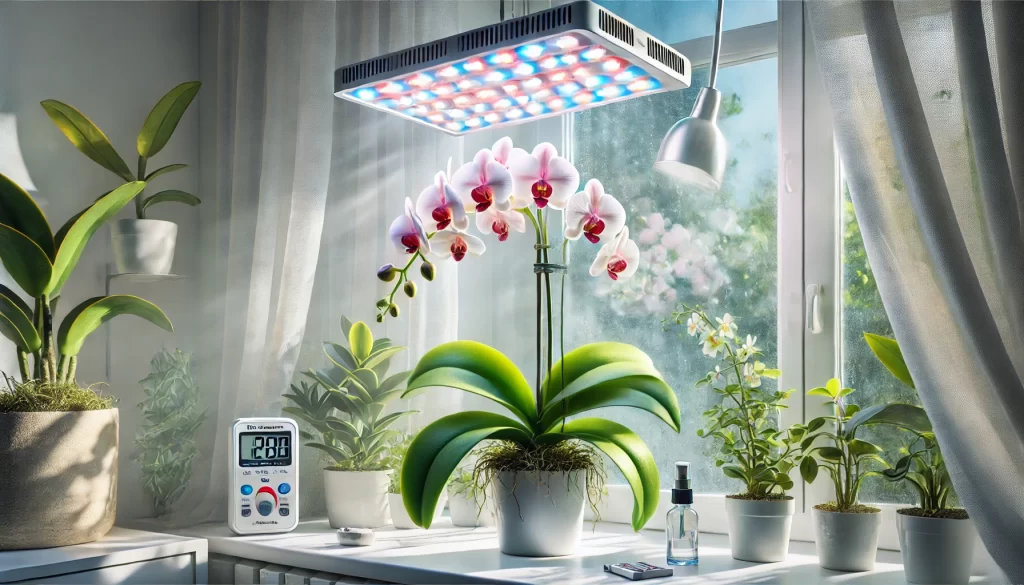
Not every home has perfect natural light. This is why artificial lighting is essential for recreating the best lighting conditions for orchids indoors. Modern grow lights are powerful, energy-efficient, and safe. Full-spectrum LED grow lights mimic natural sunlight, offering balanced wavelengths that support photosynthesis. Fluorescent tubes (T5 or T8) are affordable and effective for larger setups. Clip-on LED plant lights are convenient for small collections or desks.
Avoid incandescent bulbs: they run too hot and lack the proper spectrum. The best artificial lighting conditions for orchids combine consistent exposure with safe intensity, making it possible to grow orchids in basements, bathrooms, or offices without sufficient natural sunlight.
How to Use Artificial Light Safely
When using artificial light to supplement the best lighting conditions for orchids, positioning and timing are critical. Lights should be placed about 10–15 inches above the plant. Orchids benefit from 12–16 hours of light per day, especially in winter when natural daylight is limited. Using timers ensures consistency, preventing both underexposure and overexposure.
If your orchids receive some sunlight during the day, supplement only in the evenings or on cloudy days. Orchids also need darkness to regulate their biological rhythms, so avoid running lights 24/7. The best lighting conditions for orchids balance light and dark cycles, imitating natural environments.
Seasonal Adjustments for Orchid Lighting
The best lighting conditions for orchids change with the seasons. In winter, shorter days and weaker sunlight mean orchids may need to be moved closer to windows or supported with artificial lighting. During this time, watering should also be reduced, as growth slows. In summer, sunlight is stronger and more direct, so filtering with curtains becomes essential. Avoid placing orchids on hot windowsills where glass magnifies heat. Increasing humidity with trays of water or humidifiers helps balance the dryness of summer air.
By adapting placement and intensity seasonally, you maintain the best lighting conditions for orchids all year. This prevents stress, ensures steady growth, and supports predictable blooming cycles.
Common Mistakes to Avoid
Many beginners fail to provide the best lighting conditions for orchids because of common mistakes. Placing orchids in direct midday sun scorches leaves. Using grow lights with the wrong colour temperature results in poor photosynthesis. Forgetting to adjust light with seasonal changes leaves orchids either underexposed in winter or burned in summer. Another frequent error is leaving artificial lights on constantly, disrupting the plant’s need for darkness.
The solution is awareness. Always observe your orchid’s leaves and growth patterns, adjust gradually, and remember that orchids communicate their needs through colour and form. Providing the best lighting conditions for orchids is not static but a responsive process.
Advanced Light Optimization Strategies
For growers who want precision, tools can help refine the best lighting conditions for orchids. A light meter measures intensity in foot-candles or lux. Low-light orchids like Phalaenopsis thrive at 1,000–1,500 fc, medium-light species like Cattleyas at 1,500–3,000 fc, and high-light orchids like Vandas at 3,000–5,000 fc.
Rotating orchids weekly ensures even exposure. Reflective surfaces such as white walls or mirrors amplify natural and artificial light without increasing energy costs. Combining these techniques provides the most controlled and efficient way to maintain the best lighting conditions for orchids.
30-Day Orchid Lighting Plan
Week 1: Assess your current setup. Identify natural light sources and measure exposure.
Week 2: Adjust placement. Move orchids to windows with the best balance or set up grow lights.
Week 3: Monitor plant response. Look for signs of stress or improvement.
Week 4: Refine. Adjust distances, durations, or accessories like curtains and reflectors to perfect the best lighting conditions for orchids.
Within 30 days, your orchids will begin to show healthier leaves, stronger roots, and the first signs of reliable blooming.
Mini FAQ
Can orchids survive with artificial light only? Yes, if provided 12–16 hours daily with full-spectrum LEDs.
How close should grow lights be? About 10–15 inches above the plant.
Do orchids need darkness? Absolutely. Eight hours of night is critical for bloom cycles.
Is a sunny windowsill enough? Yes, if filtered with sheer curtains.
Can orchids grow in bathrooms? Yes, provided there is indirect light and airflow.
Useful Resources

Critical Observator offers expert tips and guides to make indoor plant care easy, enjoyable, and accessible.